 Chicago Criminal Lawyer Blog





 It’s been a tough week. You have been swamped at work and you have been busy at home with activities with the kids. Finally it’s Friday and you made it. Your co-workers invite you to go out for drinks to relax after the end of a long week and you accept. After a couple of hours at a local bar of unwinding with your co-workers and after a few drinks, it’s time to go home. You get in your car and start driving and after a few minutes you realize that you may be in no condition to drive. You don’t know if it’s the alcohol or if you are just tired from your long week, so you decide to pull over and take a nap because you don’t want to take a chance of nodding off while driving and getting into an accident. So you pull over on a side street, park your car, shut off the engine and take a nap. After a few minutes you wake up to the sounds of knocking on your car window. It’s a police officer who is trying to get your attention. You explain to the officer that you are tired so you pulled over to take a nap before heading home. The officer asks you if you have been drinking and you tell him you had a couple of drinks a while ago but had a long week and are just tired. You pull your car keys out of your pocket and the officer asks you to exit your vehicle. The officer asks you to perform certain tests and then informs you that your are under arrest for suspicion of driving under the influence of alcohol. So how can you be charged with a DUI when you were just taking a nap in your car?
This fact pattern is pretty common. Unless you understand the law in Illinois, it’s hard to comprehend how you can be charged with a DUI when you were doing the responsible thing and getting off the road when you realized you were in no condition to drive.
The key factor in determining whether you could be charged with a DUI is if you had actual physical control of a motor vehicle. Whether you had actual physical control of your motor vehicle depends on the specific facts of each case. The Court will look at the totality of the circumstances to determine whether you had actual physical control of your motor vehicle. The leading case on this issue in Illinois is City of Naperville v. Watson, 677 NE2d 955 (1977). In this case, the police found Watson sitting in the driver’s seat asleep with his head on the passenger seat. Watson had the engine running so he could have the heat on. There was no evidence that he was driving or that he was planning on driving his vehicle. Yet, in this case the Court found that he was in actual physical control of his vehicle based on the fact that he was sitting in the front seat, the keys were in the ignition and the car was running. Since he was in actual physical control of his vehicle, he could be charged with a DUI. What seemed to be important in that case was that Watson had possession of the keys to the vehicle. The Court specifically found that “sleeping it off” is not a defense to a DUI. The Court refused to give an intoxicated motorist a “good citizen discount” for realizing they were in no condition to drive. Rather the court doesn’t want someone who is intoxicated from entering a motor vehicle unless they are a passenger.
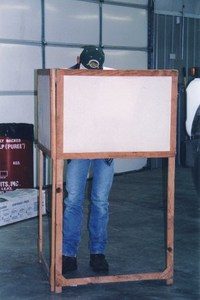 This is a question that I am asked frequently around election time. Most people do not understand what the rules are when it comes to whether you are allowed to vote if you have a felony conviction. Rules vary from state to state and this has created confusion. People don’t understand that each state has it’s own rules which requires that people with felony convictions inform themselves of what the rules are in their state. My experience with this issue is that most people are not informed as to what the law is in Illinois when it comes to felony convictions and voting rights in Illinois. Illinois has passed a specific law which spells out what effect a felony conviction can have on your right to vote in Illinois. The law is set out in 10 ILCS 5/3-5. In Illinois, a convicted felon has just as much of a right to vote as any other citizen in the state. As long as you are not incarcerated, meaning serving a prison sentence, you can register and cast a vote in Illinois. If you are in court and fighting your case, you can vote in Illinois. Even if you are in jail fighting your case. If you are on probation, you can vote in Illinois. If you are on parole, you can vote in Illinois. As long as you have not been convicted and are in prison, you can vote. However, if instead of being in prison, you are allowed to serve your sentence outside of prison, such as prison furlough or work release, you will not be allowed to vote until you finish your sentence. If you went to prison and lost the right to vote you should re-register once you are released from prison so that you can go to the polls and cast your vote.
 The recent wars in Iraq and Afghanistan have seen a dramatic rise in the number of mental health and substance abuse issues involving military veterans returning from serving in those wars. Some of these soldiers are returning home with mental health issues and are using drugs to deal with the mental health issues which such wars have caused. Those issues have spilled into the criminal justice system when these military veterans are getting arrested for crimes caused by substance abuse and mental health issues arising out of their military service. In an effort to address the specific needs of returning veterans, the Illinois Legislature passed legislation in 2009 establishing Veterans Courts in Illinois. The 2009 legislation did not require that counties establish such courts. Nevertheless, Cook County and Lake County did establish such courts. Veterans Courts are specific courts which are designed to steer military veterans out of the criminal punishment aspect of the court system and towards the treatment aspect of the court system. Specific courts have been established at 26th and California, Skokie, Rolling Meadows, Maywood, Bridgeview and Markham. The Veterans Courts in Cook County have been very successful and have been used as a model by court systems throughout the United States to help them establish their own Veterans Courts. The Illinois Legislature recently passed legislation requiring that each county in Illinois establish such a court by January 1, 2018. In anticipation of this new law taking effect, counties throughout Illinois are beginning to make plans to establish these courts. Kane County officials are aware of the new law and are beginning to make plans to start the process of establishing these courts.
 The Public Safety Committee for the Village of Schaumburg has recommended that the Village of Schaumburg allow police officers to write local Municipal Violation tickets for first-time negligent driving offences. The measure is intended to go after drivers who are using hand-held cellphones while they are driving instead of hands-free devices. Village officials claim that the judges at the Rolling Meadows Courthouse are taking these tickets too lightly and not punishing offenders enough.
 You can be charged with Interfering with the Reporting of a Domestic Battery when you prevent a family member from making a call to report a Domestic Battery incident. You can also be charged with Interfering with the Reporting of a Domestic Violence charge if you interfere with a family member who is reporting the incident to the police. It is very common to see this charge added to a criminal Domestic Battery charge.
 Illinois law has made a special type of Probation available for first-time felony drug offenders to avoid a felony conviction on their record. This type of Probation is commonly known as Section 410 or Section 1410 Probation. In order to be eligible for this type of Probation, you cannot have previously been convicted of, or placed on Probation or Court Supervision, for any criminal offense related to Cannabis or Illegal Drugs. This includes Prescription Drugs. If you are eligible for this type of Probation, here’s how it works:
 The gun violence in Chicago has been a great source of concern among the citizens and politicians in Illinois for a long time. Every day we are inundated with news of shootings and homicides throughout the City. When the weather heats up we know that the number of shootings will go up. On Monday morning we open the paper to find out how many people were shot and how many were killed over the weekend. In the effort to come up with a way to stop all the shootings, we need to understand how illegal guns are making their way to the streets of Chicago. Illinois has some of the most restrictive gun laws in the United States. To own a gun in your home, Illinois requires that you get a Firearm Owners Identification (FOID) Card which requires that a thorough background search be conducted by the Illinois State Police. FOID cards can be revoked for good cause by the Illinois State Police. Citizens are generally not allowed to carry a gun outside their home unless they have an FOID Card and are legally transporting it, or they obtain a Conceal and Carry Permit. To obtain a Conceal and Carry Permit you have to apply to the Illinois State Police, submit to a thorough background search and supply your fingerprints, and attend and complete gun training classes. Illinois was the last state to allow conceal and carry, and that was only after the Federal Courts ordered Illinois to do this.
 Whenever I get a phone call from someone who is facing a Violation of Probation, the most common question I get is whether they will go to jail for their Violation of Probation? This is another impossible question to answer. While everybody wants an answer to their question, some questions are just too difficult to easily answer. This is perhaps one of the most difficult question to answer. Let me explain why.
 One of the most common questions I get asked when I get a phone call from somebody who has recently been arrested is “can my case be dismissed if the police did not read me my rights when I was arrested?” The answer to that question requires an understanding of the Fifth Amendment to the United States Constitution. Everyone has heard of the Fifth Amendment, especially because of television crime shows, but let’s take a closer look at why the Fifth Amendment is important, what it is and what it does.